The science behind D68
A surfactin-family lipopeptide, produced by a selected Bacillus strain and screened for one job: keeping pathogenic bacteria from taking hold in the gut.
How it works
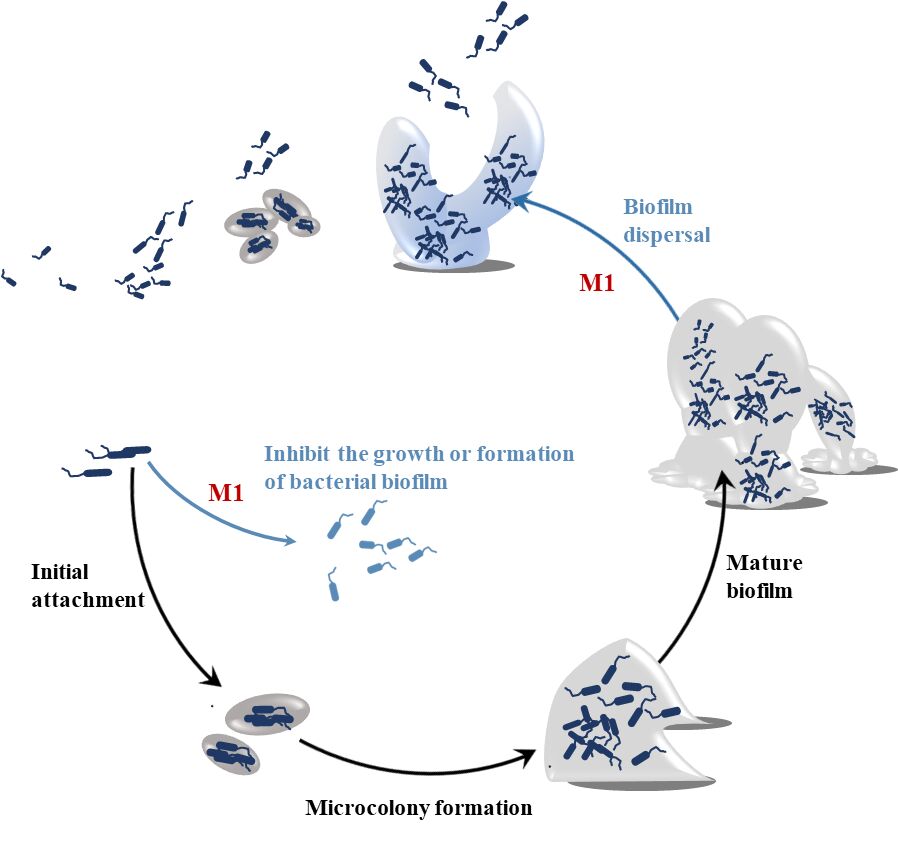
D68's core molecule is a cyclic lipopeptide: a ring of seven amino acids linked to a beta-hydroxy fatty acid. It acts on bacteria in two ways, depending on concentration.
At low levels it interferes with quorum sensing, the chemical signals bacteria use to coordinate and build biofilms, so colonies struggle to form. At higher levels it penetrates mature biofilms, breaks bacterial membranes and disperses what remains, which stops pathogens from attaching to the gut wall.
Conventional antimicrobial peptides punch holes in cell membranes through electrical charge. Used long-term, that single mode of action can select for resistant strains. D68's biofilm and signalling route avoids that trap.
How the strain was found
D68 came out of a systematic screening program that combined multi-omics with layered functional testing, so strain selection was driven by data rather than chance.
Sample & sequence
High-throughput sequencing to profile microbial diversity and spot differential microbiota.
Isolate
Target strains isolated and grown in pure culture under controlled conditions.
Test function
Phenotypic and functional assays for the traits that matter in production.
Identify
Molecular sequencing confirms strain identity and genetic uniqueness.
Characterize actives
Key bioactive proteins purified and identified by mass spectrometry.
Antibacterial activity
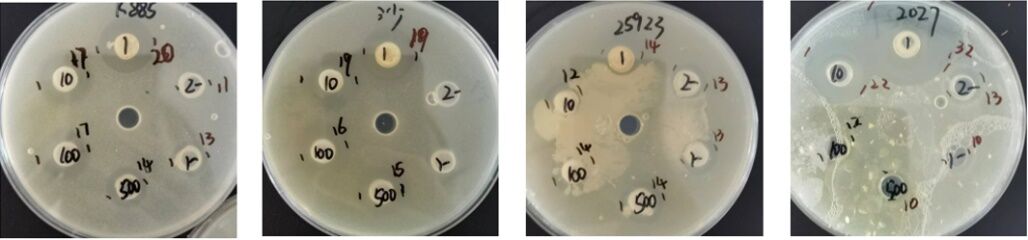
Measured by agar well diffusion (Oxford cup): D68 is placed in a well and the clear zone where bacteria fail to grow is recorded. Higher dilutions that still produce a zone mean stronger activity.
| Pathogen | Relevance | Result |
|---|---|---|
| Escherichia coli K88 | Swine, poultry | Inhibited at 1:500 (1:2000 in a second lab) |
| Salmonella spp. | Poultry, food safety | Inhibited at 1:500 |
| Staphylococcus aureus | Poultry, dairy | Inhibited at 1:2000 |
| Clostridium perfringens | Necrotic enteritis | Inhibited at 1:2000 |
| Riemerella anatipestifer | Ducks | Zone >10 mm at 1:2000; a commercial antimicrobial peptide showed none |
| Vibrio harveyi, V. parahaemolyticus | Shrimp, fish | Zone >18 mm |
Tests run independently at several partner laboratories, including a pharmaceutical lab and an international feed company.
Safety
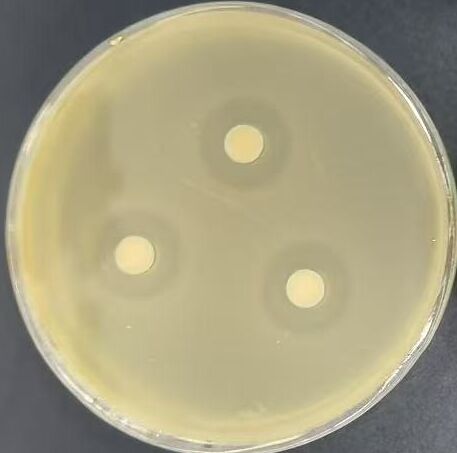
The D68 strain carries no acquired antibiotic resistance. It is fully susceptible to all eight antibiotics tested, with inhibition zones of 23 to 46.5 mm: cefradine, erythromycin, chloramphenicol, clindamycin, norfloxacin, amikacin, carbenicillin and gentamicin.
Animal safety studies found no lesions in the heart, liver, spleen, kidneys, jejunum, ileum or colon. The strain is not genetically modified or gene-edited.
Manufacturing
D68 is produced by submerged liquid fermentation, then concentrated and spray-dried or carrier-dried at low temperature to preserve the active compounds. The finished powder contains at least 1×10⁹ CFU/g of the producing Bacillus together with its metabolites, including lipopeptides, protease and amylase.
The strain grows quickly and tolerates heat and bile salts at 0.1 to 0.3%.
D68 compared with antimicrobial peptides
| D68 postbiotic | Typical antimicrobial peptide | |
|---|---|---|
| Mode of action | Quorum-sensing interference, biofilm disruption and immune support | Charge-based membrane damage; can select for resistance |
| Spectrum | Broad: Gram-positive and Gram-negative | Often narrow, aimed at specific bacteria |
| Stability | Heat- and acid-tolerant | Readily broken down by proteases |
| Added value | Digestive enzymes and metabolites support feed efficiency | Antibacterial only |
| Cost in use | Low production cost, competitive inclusion cost | Expensive to produce |
Want the full technical dossier?
We can share detailed lab reports and trial protocols with nutritionists and QA teams.